
WORKERS’ STRUGGLE GAVE BIRTH TO MAY DAY
140 years since the Struggle for 8hours Work day, Anti-Workers Policies; Casualization, Poverty Wages, Mass Unemployment Remains the Main Features!
May Day Shouldn’t be a Jamboree or a Day to Agonise but to Organise Against Capitalism!
By Seyi Lasisi
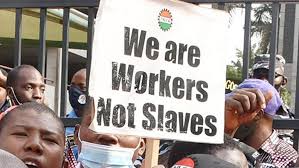
On May 1, 1886, workers in the U.S. and Canada held strikes and rallies to demand an eight-hour workday. The demand for an eight-hour workday was motivated by the incessant exploitation of the proletariat by the bourgeoisie under industrial capitalism. The factory owners wanted to continually extract surplus value by extending working hours and intensifying labour.
By the 1860s, workers had already begun campaigning for shorter working hours in many countries. Also, by the 1880s, U.S. industrialisation had concentrated workers in factories, railroads, and cities. This created the material conditions for a self-conscious working class. Thus, on May 1, 1886, workers in Canada and the United States held peaceful strikes and rallies to demand an eight-hour workday; it was a collective action by the proletariat asserting its class interests against capital.
To honour that struggle, the International Workers’ Congress in Paris declared May 1 an eight-hour holiday in 1889. The Second International formally recognised it as an annual event in 1891. Today, it’s celebrated in over 160 countries to honour workers’ contributions and promote labour rights.
In Nigeria, Nigerian workers gather for parades, rallies, and speeches. Traditionally, the Nigerian Labour Congress (NLC) president and other politicians address workers. For years, the Nigerian May Day has been used for stock-taking by organised labour and employers, celebrating achievements like the minimum wage while highlighting ongoing challenges. However, the Nigerian May Day has been slowly disentangled from its original origin of struggle to improving the working and living conditions of workers. This has created a space for anti-worker policies to thrive and casualisation to be inclusive.
A study by the International Journal of Business and Social Science describes casualisation as a form of temporary employment that has become a permanent job, yet lacks statutory benefits such as adequate pay, medical insurance, and a pension. The system also prevents casual workers from exercising the right to unionise. According to a 2018 Nigerian Labour Congress report, an estimated 45 per cent of Nigerian workers are casual workers, with a high prevalence at both the federal and state levels across all sectors.
The Nigerian Minister of Labour and Employment, Muhammad Dingyadi, noted that many organisations now rely on casual and contract staffing to cut costs, often at the expense of workers’ security and rights. This exploitation is common across different sectors in the country.
In 2011, for instance, the Nigerian Labour Congress shut down 15 Airtel Communication showrooms across the country to protest the alleged casualisation and dismissal of 3,000 workers. In 2024, HumAngle published an investigation into the maltreatment and exploitation of some casual workers at the Dangote Refinery in Lagos. There is also unprecedented exploitation in the marine industry, with dock workers engaged like peasant workers whose human and labour rights are not protected.
Sponsored by Senator Ayo Akinyelure (PDP, Ondo Central), the Prohibition of Casualisation Bill 2020 passed its first and second readings and was referred to the Senate Committee on Employment, Labour, and Productivity to report back. Six years later, the bill has neither become law nor been signed.
In Nigeria, outdated labour laws with weak enforcement continue to allow casualisation. Section 7 of the Labour Act requires written terms after three months, but there is “no adequate consequence for noncompliance.” As highlighted, the bills to prohibit casualisation have been shelved. When Nigerian employers sack casual workers without benefits, the state’s inaction reveals its class character.
According to the Nigerian Bureau of Statistics, the unemployment rate in Nigeria increased to 4.90 percent in the fourth quarter of 2024 from 4.60 percent in the third quarter of 2024. This army of unemployed and underemployed workers allows factory owners and employers to compel graduates and skilled technicians into casual roles with no security. Banks had 42% contract staff who “can work for years without a raise, promotion, benefits or security.”
The Association of Senior Staff of Banks, Insurance and Financial Institutions estimated that as of late 2025, about 60–65% of Nigerian bank staff are casual or contract workers, a practice used by banks to minimize operational costs, pensions, and benefits.
The weak Nigerian labour unions have further allowed this exploitation to persist for decades. Weakened unions cannot effectively enforce collective bargaining. Thus, until the working class—through unions like the NLC, TUC, and left-leaning and revolutionary organisations—challenges capitalist property relations and forces the state to serve labour, the Nigerian ruling class will continue to use casualisation to discipline and exploit working-class citizens.
Historically, May Day, International Workers’ Day, is not a day of festivity. It is not merely an off-work day for eating, drinking, and dancing. It is not just about match-past and uniform displays. It is a significant day when workers across the world make their demands known to the ruling elites, resting on the rich history of struggle and inspiring itself to continue on the same path to win more gains for the working class. In the Nigerian context, it should be a day to make demands on the Tinubu regime regarding its promises. It is a day to further call for an increase in the minimum wage. Above all, it is a day of united struggle to qualitative move from placing demands on capitalism regime to posing the question of power.
However it is important to also take stock of the whole history of the working class, since 1886, when it stepped out in struggle for a 8 hours working day. And draw the conclusion that all the gains that have be won was occasioned by the struggle of the working class. And no soon is the system stable that these gains come under attack. A consequence of the fact that capitalism is grounded as a system of exploitation of the sweat and labour of the work force to guarantee super profit for private capital. And that ultimately there is the need move from agonizing to organising the working masses to overthrow capitalism. A task that has become an agenda for the whole of the working masses in all countries of the world, as imperialism under the dominate hold of a Trump-led US seek to impose a singular dominant unipolar world order through war and disorder on the whole of humanity.
The working class everywhere must see its role in the growing crisis as one that leaves with no choice than to come forward like it did in 1886 to frontal put forward its demand for a fair share of the product of its daily toil and sweat and for the wealth of society in general. Even this is not enough today, it must qualitatively take a leap from 1886 to 1917 and draw inspiration from the revolutionary struggle of workers and poor peasants in Russia, under the Bolshevik leadership of Lenin and Trotsky, successfully overthrowing capitalism.
The very first step in this direction is coming to an understanding that the working class must take up the task of building a mass Working People Party that will ensure that the working masses organise themselves independently, will the set goal to win political power. This is the agenda for today, but in the neocolonial countries of Africa, Latin-America, Asia, and in the Middle-East, as well as in the advances capitalist of Europe alongside the major imperialists’ countries of the US, Russia, China. Even in the defunct Stalinist countries of Eastern Europe. The quest for a better universe where, the entirety of the working masses, worldwide will freely be able assess the wealth of society. This is the only sense that struggle of workers in the US, 160 years ago to achieve for workers worldwide the celebration of workers day as a public holiday, can fully come into fruition, by set the agenda of the liberation of workers from the exploitative rule of capital. The liberation of society and the end of the exploitation of workers are one and the same task that can be accomplished by abolition of the capitalist system.